The Twelve Blockers to Product-Market Fit
An Extra Group Framework
The classic reasons for startup failure are well-documented. Low product-market fit. Running out of capital. Poor market timing.
Every founder is acutely aware of these risks, and is working tirelessly to avoid them. And yet, despite this, most startups aren’t feeling the flywheel turn effortlessly. Momentum isn’t there, and revenue’s not where it should be.
Most startups struggle with product-market fit or fail for a reason that’s not often discussed: startups haven’t properly identified the unique blockers standing between them and product-market fit.
When startups don’t properly diagnose what’s in the way, they stay stuck. They spend time and capital building or fixing elements of their go-to-market strategy that were never going to create increased revenue. They don’t spend time on what’s most broken, simply because they can’t fix what they can’t see. This is what causes startup failure.
In order to find PMF and build a GTM playbook that reliably delivers growing revenue, startups must identify and address all blockers at play. The Extra Group’s Twelve Barriers Framework give startups a way to identify which blockers they’re really facing, so they can address what’s actually broken.
Where the Twelve Blockers Framework Came From
Our founder Caroline Fay started to notice this pattern early into her work as a fractional GTM leader and advisor. The startups she worked with were not lacking hustle. They poured energy into finding product-market fit every day. But that effort didn’t often yield results – because they’d identified the wrong causes of their lack of traction.
Some startups were adding more leads to the funnel, but they were targeting the wrong buyer
Some startups spent time and money to hire a sales team, but they’d hired too early and didn’t have enough clarity to set hires up for success
Some startups moved into new markets, assuming they were selling to the wrong buyer, but their lost deals were actually due to poor sales processes
Without a clear-eyed identification of all the blockers that are slowing growth, these startups wasted precious time and money on efforts that didn’t accelerate growth, because they didn’t solve the real blockers in play.
This pattern showed up consistently across early-stage startups, spanning industries and ranging from the earliest idea phase through post-seed. If a startup was experiencing low revenue velocity, it was always due to a blocker that hadn’t been acknowledged or addressed yet.
In retrospect, Caroline saw this failure to identify PMF blockers as the single strongest headwind for her prior startup, Skillist. Skillist had happy customers, which led her and her team to assume they were closer to product-market fit than they really were. Their pipeline was full of leads, but they had a low close rate and their churn rate wasn’t great. The root cause was a failure to identify a key blocker at play: they hadn’t done enough analysis on real demand signal. They were selling to anyone who would buy, which left them with a muddled GTM strategy, an unreliable sales playbook, and low repeatability. Skillist was ultimately acquired, but the team wished they could’ve continued to grow the company and its revenue independently. It might have been possible if they’d identified the true blockers to product-market fit.
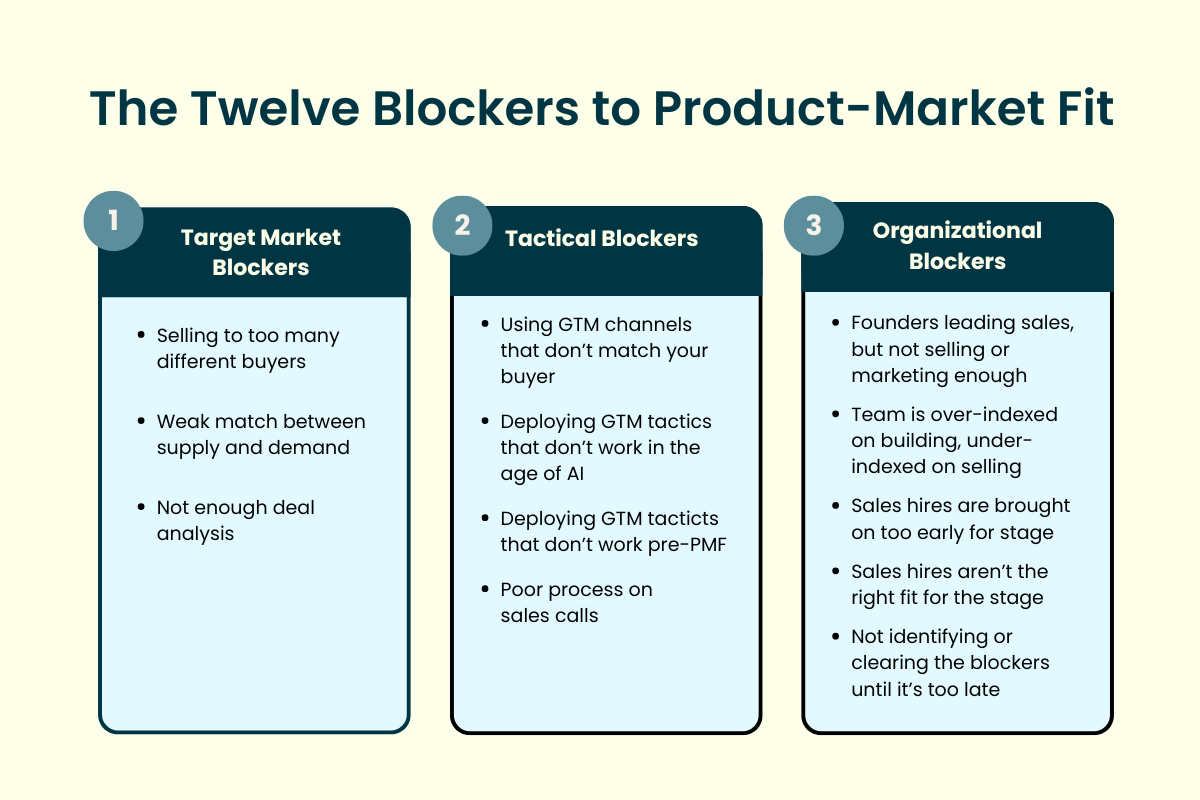
The Twelve Blockers to Product-Market Fit
Category #1: Target Market Blockers
1. Selling to too many different buyers: When startups sell to anyone, they exponentially increase the amount of noise that must be sifted through, when the most important thing to do to get the PMF flywheel spinning is to instead isolate strong signal from one key buyer.
2. Weak match between supply and demand: If a team isn’t closing sales repeatably, they may not have gotten their customer’s needs right. It’s easy to attribute lost deals to something like “I didn’t create enough urgency,” or “they lost their budget, but otherwise they really wanted it.” In these cases, what’s usually happening is that the startup has over-estimated their target market's desire to buy, or misunderstood their truest needs.
3. Not enough analysis on deal analysis: Without analyzing insights from closed deals (both won and lost), startups miss key insights about what kind of buyers have real demand, and how to properly sell to them. There are so many datapoints to sift through: from sales calls, to deals, to psychographics, to buyer segments. Identifying the attributes of a buyer who simply must have your product can be what takes your startups from low momentum to undeniable traction.
Category #2: Tactical Blockers
4. Using GTM channels that don’t match your buyer: The way to bring prospects into the funnel depends a startup’s unique buyer type. Startups shouldn’t build an outreach strategy around email if their prospects don’t use email, or if they send every cold email to the trash. To create a healthy top-of-funnel, startups must reach buyers through channels and activities that are custom-fitted for them.
5. Using GTM tactics that don’t work pre-PMF: Startups often look to GTM tactics that are common for later-stage companies, like automated outbounding or LinkedIn InMail campaigns. However, late-stage companies have product-market fit and clarity on their target market and buyer psychographics. Early startups don't. Even when a company knows their value prop like the back of their hand, automated outreach campaigns have very low response rates. Later-stage companies also have large marketing teams that can manage these lower-yield GTM activities. Simply put, early-stage startups don’t have the same time, runway, or clarity as late-stage companies, so their GTM tactics should look different.
6. Using GTM tactics that don’t work in the age of AI: AI has enabled every company to outbound more. A lot more. This has inundated inboxes, and raised buyers’ defenses and skepticism. Outreach that is undeniably human (whether it’s digital or in-person) is what works. In the age of AI, founders need to stand out from the run-of-the-mill canned outreach that doesn’t work, and orient toward quality, not quantity.
7. Poor process on sales calls: Most founders have never sold before, and they are highly passionate about the product they’re building. These two factors create the conditions for avoidable selling mistakes: pitching too soon, pushing the product instead of pulling out insights, and doing too little discovery.
Category #3: Organizational Blockers
8. Team is over-indexed on building, under-indexed on selling: Many founders wait until their product feels ready to start selling, but those startups have then built a product based only on hypothetical data. There is an ocean of difference between a target customer who says “I would use this tool” in a discovery interview, and a target customer who has such a strong need that they will actually spend money and effort to buy a product. More product isn’t the solution startups often think it is.
9.The founder’s leading sales, but not selling or marketing enough: Founders should lead sales for as long as possible, because of how valuable the insights from sales calls are. But volume matters. Startups need a meaningful sample size of calls to understand if there’s real demand. Founders must commit time to sales every day, which requires the reprioritization and delegation of other workflows.
10. Sales hires are brought on too early: Founders look to hire sales help, usually a sales rep or a Head of Sales, for a variety of valid reasons: they’re new to selling, there are other competing priorities, they want more expertise on their bench. But more often than not, the startup isn’t actually ready for that hire, because they haven’t gotten clear on who buys and why. If startups don’t have a strong draft of their sales playbook, a sales hire won’t be successful (or happy), and the founder will end up back at square one.
11. Sales hires aren’t the right fit for stage: Once startups have proven clarity on their buyer and a strong sales playbook (which usually happens once they have at least fifty customers that look the same), hiring a rep or Head of Sales should accelerate revenue. Those hires need to be the right fit for early-stage. The playbook is still being built, and there is much unknown. If a founder hires someone who is used to post-PMF clarity, they may struggle to turn results.
12. Not identifying and clearing blockers until it’s too late: I often work with folks who have spent months or years solving for the wrong blockers. At that point, these startups have less runway and time to fix the true blockers at hand, or they might even be in true crisis mode. It’s really tough to know what’s actually standing in the way of revenue growth – it’s like trying to read the label from inside the bottle. Great startups will be proactive about when they need help because it gives them more time and runway to fix what’s not working.
How to Use the Twelve Blockers Framework
The Extra Group’s Twelve Blockers Framework helps startups and founders move from sluggish revenue growth to recurring revenue, a reliable GTM playbook, and clear product-market fit. With this clarity, founders can do more with less, and teams can galvanize around and execute on the work that needs to be done most.
Founders and startups use this framework to:
Identify which blockers their startup is uniquely facing, and how they are most affecting growth
Prioritize and plan work that address those key blockers
De-prioritize workstreams that are less likely to lead to revenue growth
The Extra Group uses the Twelve Blockers framework as a diagnostic when working with startups. In our GTM Sprint, which starts every advising or retainer engagement, we run a brief, proprietary blocker assessment. This framework and assessment surfaces what is likely to be causing a lack of GTM momentum. Once a startup can see their blockers clearly, they can make changes, prioritize activities, and create plans that address what’s most broken. Teams stop wasting time and energy, and put attention, capital, and resources towards where it's needed most.