The Sell-to-Learn Cycle
An Extra Group Framework
The majority of a founder’s time is spent making decisions without full context. They don’t have certainty if buyers want their product until they sell it. They don’t know why buyers buy (or don’t) until they ask. They don’t have proof on whether a go-to-market activity will work until they test it.
The average early-stage go-to-market process feels like messy trial and error. Finding product-fit just isn’t linear.
That’s why the process for finding PMF shouldn’t be linear either. Instead, it’s cyclical. Rather than selling ad hoc, startups run focused cycles: selling to one buyer at a time, in order to learn, and accelerating momentum as they go. The Extra Group’s Sell-to-Learn Cycle gives startups a sales structure that matches the realities and necessities of selling early-stage.
Running sell-to-learn cycles helps to reveal one real, viable pocket of demand from the market, and become excellent at selling to that buyer. It helps startups avoid scattershot selling to too many buyer types at one time. It helps them make sense of the many, many datapoints you’re gathering from all their sales efforts.
As a startup runs cycles, they drill down, getting closer and closer to a repeatable sales process that works reliably for one high-demand buyer type.
Here’s what it looks like:
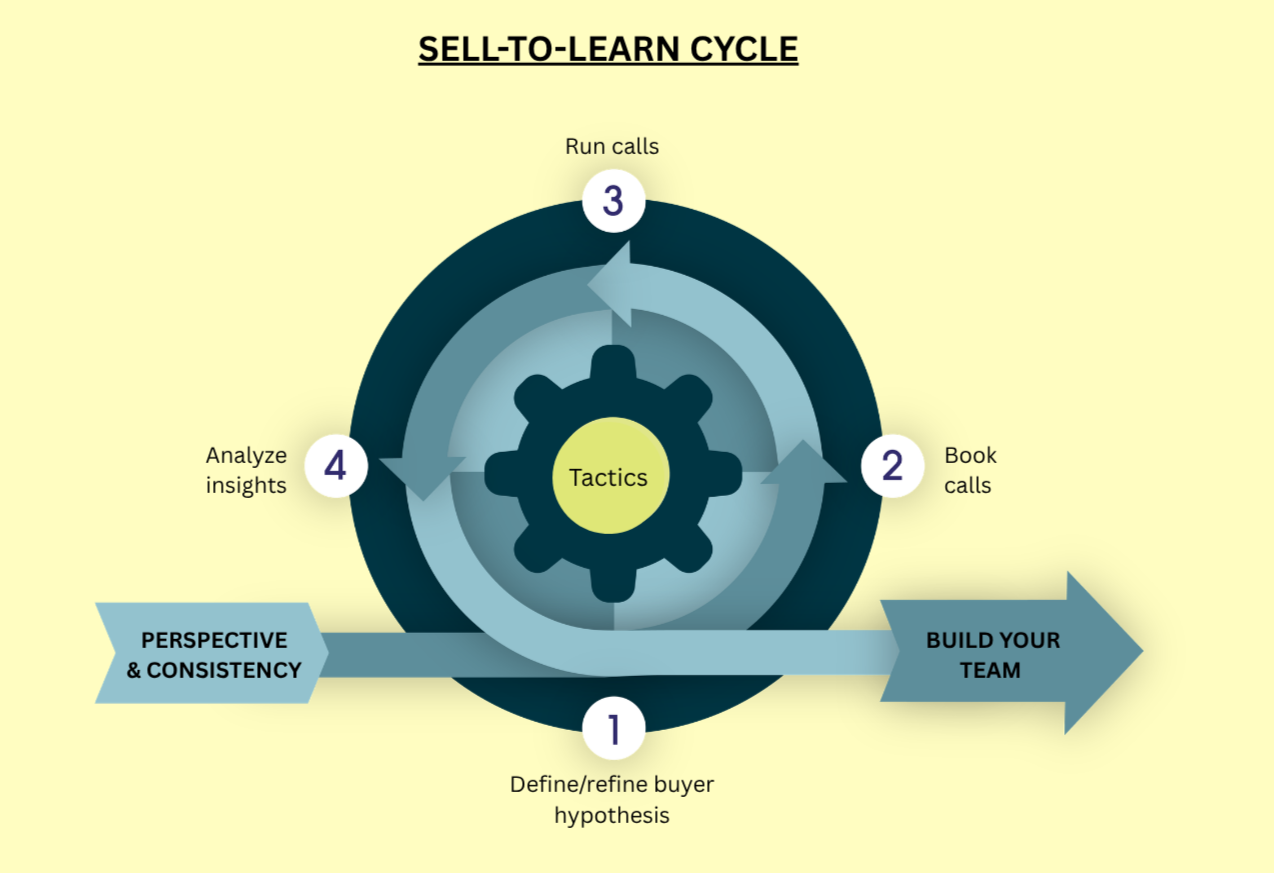
The Four Steps of the Sell-to-Learn Cycle
Step 1. Define the buyer hypothesis. A startup will ask itself: “Who do we believe has a true demand for our solution? What is that buyer trying to get done, and why?” Notice that this step isn’t just about defining the “who” – that is a surface-level definition that won’t serve startups. Instead, startups must build a hypothesis on what the buyer wants to get done, and why.
Step 2. Book calls with a handful of those buyers.
Step 3. Run calls with those buyers, and test the hypothesis from Step 1. This means sales calls will be curious and conversational, NOT a pitch. The thirty minutes that startups get with prospects is precious and extremely valuable. Startups must ensure they spend that time deeply understanding their demand, rather than talking about their supply. If a startup finds that the prospect matches the hypothesis and has demand, they should sell to them. More often than not, the prospect doesn’t have demand, or they don’t quite match the hypothesis. In this case, a startup’s job is to dig in further to better understand what the prospect really needs.
Step 4. Systematically analyze the insights from these calls. In this Step, startups will reflect on assumptions made about their buyer that were disproven, and learnings that they can leverage going forward.
Step 4 concludes the Sell-to-Learn Cycle, and startups return to Step 1. At this point, instead of defining the hypothesis, they’ll refine it with learnings from the market, earned during the prior Cycle. Startups will test their refined hypothesis in a brand new cycle.
Startups should aim to run tight and efficient cycles, with one taking about 4-6 weeks. As they run cycles, they will get closer and closer to a proven hypothesis. This process ensures that they’re taking thoughtful and strategic steps towards a repeatable sales cycle and product-market fit, rather than selling ad hoc.
Two Factors to a Successful Cycle
To run a cycle well and prevent backsliding into GTM chaos, startups must come in with the right perspective and a commitment to consistent selling.
Perspective: Founders and teammates must be willing to be wrong. They need to let their customers tell them what they actually have demand for, even if it conflicts with prior assumptions. Startups need to try to test one hypothesis at a time so they can parse actionable signal from the noise. Without this perspective, startups revert to pitching your product to all different types of buyers, which does not enable them to capture clear market insights that direct you to PMF.
Consistency: Startups, and namely the startup’s founder, must commit real time, daily, to selling. To run a cycle, they will need to run at least five sales calls. Without this, there won’t be a critical mass of insights to analyze. In order to book those five calls, startups will likely need to reach out to at least 50 prospective customers.
Startups need to run regular outreach in order to book those calls. Doing so in a concentrated fashion enables a tight cycle: one that gathers market insights swiftly, and allows teams to iterate and pivot fast. On-and-off outreach slows momentum and hinders startups’ ability to learn real-time insights from the market.
Suffice it to say, two significant but underrated factors in your journey to product-market fit will be consistent outreach and a demand-focused perspective. If your cycles break down, it may be a perspective or consistency issue that is causing it.
When to Stop Running Cycles
Every startup takes multiple cycles to find true product-market fit. Running cycles will enable startups to do so faster, because it uncovers potent insights that create momentum.
Startups may learn in their first cycle that not one of the ten buyers they spoke to exhibited real buying interest. They’d then go back to the drawing board, and test a new buyer type. Uncovering an insight like this clearly in an early cycle can save months of dead-end selling.
Startups may learn in their second cycle that the prospects who have real demand use very specific language or wording to explain their need. They can then integrate that learning directly into their messaging on the next cycle.
We recommend that a founder keep running the sales process and refining the hypothesis until they see signs of product-market fit: meaning, the same kind of buyer repeatedly buys your solution, for the same general reason. The buyer regularly pushes the deal forward. They show true need, using terms like, “When can we get started?” instead of vague compliments.
At this point, a founder can stop running cycles and add in the final ingredient for repeatable sales: building a sales team.
Hiring a sales rep or Head of Sales makes sense when startups have some semblance of a sales playbook coming together. We usually see this at around fifty repeatable sales of the same product to the same buyer. Hiring any time before that, and the seller you’ve hired will not have enough information to execute. They are more likely to slow momentum, rather than accelerate it.
How to Use the Sell-to-Learn Cycle Framework
The Extra Group’s Sell-to-Learn Cycle helps startups and founders to have the right level of structure for their nascent sales motion. Startups move from scattered selling to a process that matches and accelerates their early-stage GTM journey. It gives founders a way to make every sales effort count, by gathering real market insights, isolating true demand signal, and building on itself until they have a repeatable sales process.
Startups use the Sell-to-Learn Cycle to:
Bring structure and accountability into their sales process
Identify what failpoints or Blockers are occurring in their GTM motion
Identify which buyer types have real demand for their solution, and why
Build and refine a buyer hypothesis with each cycle, rather than selling to anyone who will buy
Make sense of the insights gathered across sales calls, and translate them into a clearer GTM strategy
Move deliberately toward product-market fit, rather than staying stuck in trial and error
If you're pouring energy into selling but struggling to find traction or make sense of what the market is telling you, the Sell-to-Learn Cycle gives you the structure to move forward with clarity.
The Extra Group uses the Sell-to-Learn Cycle as the foundation of our work with early-stage startups. Both in our advisory work and within the Repeatable Sales Club, we help founders run tight, efficient cycles so they learn fast and reach product-market fit as quickly as possible.